Friday, 8 March 2013

Circus investigation number 3: The tight rope

In our final investigation we wanted to find out which would be the best type of rope to do a tight rope walk on.  With all the work we'd been doing on forces and motion, we've learnt about pushing, pulling, twisting, sliding, gravity, motion and friction.

As it would be too difficult and dangerous to do tight rope walking in school, we did an investigation with balloon rockets to find out which type of rope caused the most friction, and would therefore be easier to grip on to with your feet.

As with all our investigations we made predictions.  This time it was really difficult.  There was coarse white string that we use in class, some fuzzy wool, and some really smooth cotton. A lot of us predicted that the fuzzy wool would provide the greatest friction.

"I think the wool because it has got all bits of it"
"the wull bicoz its reely tickly"

However... when we tested it out we found out something completely different!
The first rocket in this video is the coarse string, and the second is the wool.

As you can see, the balloon rocket on the wool shot all the way to the end, because there was less friction affecting the motion of the rocket.  The air pushed the rocket all the way along the wool.  However the coarse string caused that much friction that it slowed the balloon rocket down and made it stop at about half way.

Tuesday, 5 March 2013

Circus Investigation Number 2: Dumbo's Ears.

Carrying on with our science investigations on forces, we watched a clip of Dumbo flying. We had a chat with our learning partners about how he can fly and 'popcorn'ed some ideas.

"He's got a magic feather"
"But in the end he doesn't need it"
"He flaps his ears and can fly"
"His ears are like wings"

With a bit more chat realised that gravity was trying to pull Dumbo down, and somehow he used his ears to slow down his fall.

We wanted to find out whether if Dumbo had smaller ears, would he fall to the ground quicker.... time to investigate.


We used gyrocopters to do this experiment.  The blades were Dumbo's ears, the body was his trunk, and the paper clip was the magic feather.

We made an orange 'control' gyrocopter, and then made white gyrocopters with our chosen variant   Some of us chopped Dumbo's ears shorter... or chopped one off completely!  Some added more magic feather paperclips to the end of his trunk.  The important thing was that we only changed one thing.


Testing that our control gyrocopters work.


We drop both at the same time and see which one falls the fastest.


We wrote up our investigations, including the predictions and the results.

What we found out...

If we added weight to the gyrocopter = it dropped quicker than the control 'copter

If we shortened the 'ears' = it dropped quicker than the control 'copter

If we chopped one 'ear' off = it dropped quicker than the control 'copter

At the end of the lesson we had found many ways for speeding up the fall of the gyrocopter, but hadn't found a way of slowing it down.... so we had a think.


Some suggestions were:

"Make the ears longer"
"Make the trunk longer"
"Take the paperclip off"

Do you think any of these things would work?  Why not try it out at home?


Thursday, 28 February 2013

Circus investigation number 1: The human cannonball.

The first science investigation we have done as part of this topic was looking at the human cannonball.  We watched a video of a man being shot out of a cannon at the circus, and then talked about all the forces being used.

We decided that the man was pushed out of the cannon, and that gravity pulled him back down again.


We decided to investigate whether you would fly further through the air if you were lighter or heavier, and to do this we used mangonel catapults and playdough.

We activated our investigation brains and loosened our bodies with a special dance and sing along to this song.


We discussed our predictions with our learning partners and filled in our investigation sheets, and then went to the hall to investigate.

The mangonels are loaded and pulled back

The playdough is pushed through the air, and then pulled down to the ground by gravity.

We found out that the lightest peice of playdough went the furthest.

The Circus comes to Lound.

Our new topic is The Circus.  We'll be doing loads of science investigations to do with forces and some letter writing and poetry.

After thinking about what we knew about circuses in the past and in the present, we wrote a letter to the circus asking if they could come and answer some questions for us... and on Wednesday they came!

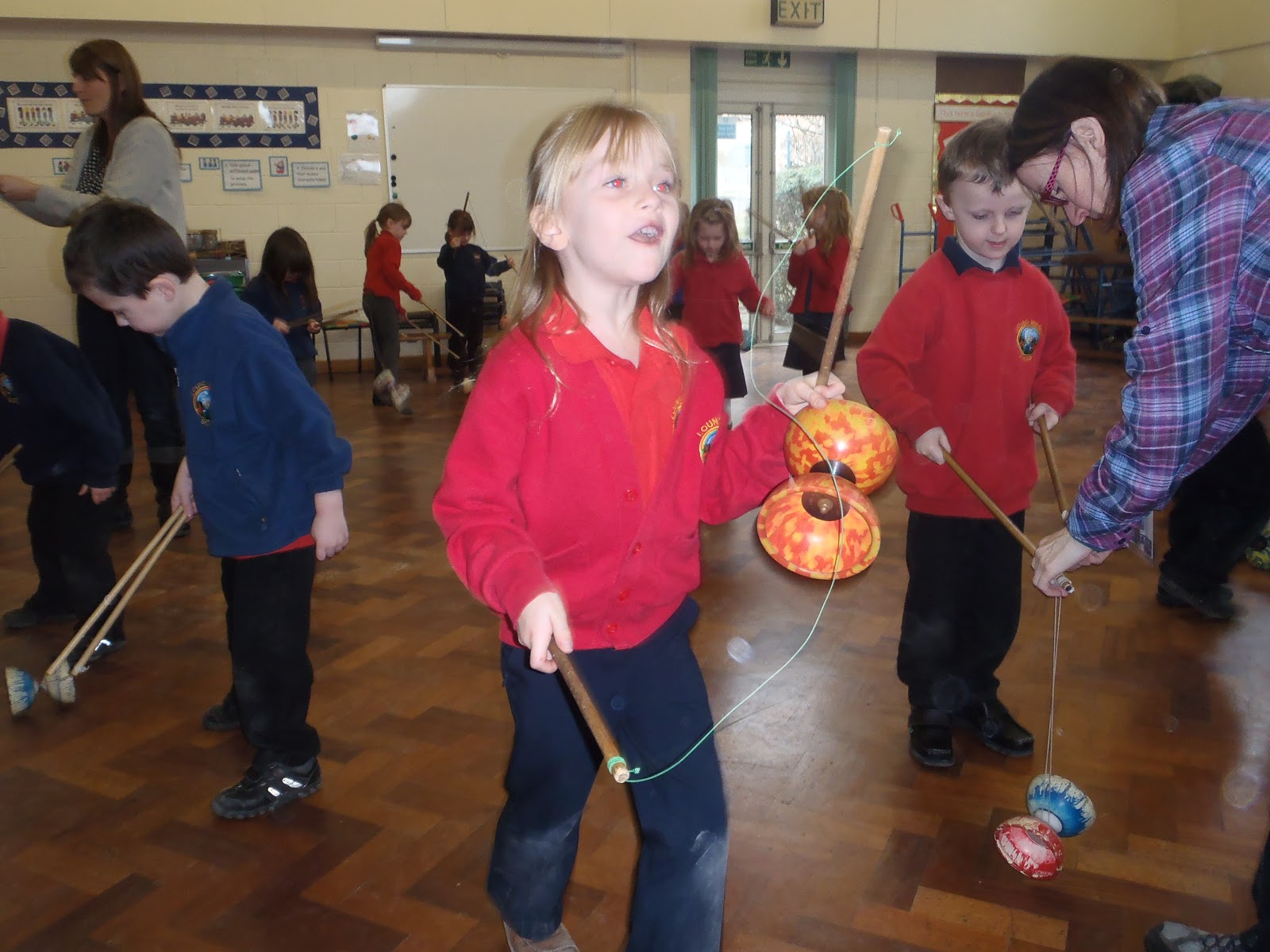
Trudy taught us different circus skills including juggling, flower sticks, diablo and plate spinning.  Here are some photos.


Thursday, 14 February 2013

Portside Pirates

This is the song we've been using to 'activate' during our Pirates and Mermaids topic.  Lots of marching, pointing directions and playing 'row-your-boat' with a partner.


Recently in maths...

...We've been very busy!

In data handling we've been learning about Venn diagrams and consolidating our understanding of pictograms, block graphs and tally charts
Our first attempt at sorting shapes that are blue and shapes that have 4 sides using a venn diagram.

Hard at work studying pictograms.

Our human pictogram showing how common each different eye colour  is.


We have also been working on halving, finding halves of shapes, and halving a number of objects.  We practiced this on Monday be cutting lots of things in half including paper plates, ribbon and fruit; and half filling different containers with snow (yes... snow again!)  On Tuesday we used our halving skills to share a pancake equally with our learning partner, making sure we shared the raisins, banana slices and smarties equally before cutting our pancake in half and eating it.
I cut an apple in half

Lots of practice at finding half

The pancake feast begins
Also this week we have been learning to use metre sticks to measure things.  We have been using metre sticks to find things around school that are longer or shorter than a metre, we have been creating structures that are exactly 1 metre high or long, and we have been measuring distance using metre sticks.

Nearly a metre...

We made our own metre stick

We measured how far we could throw a beanbag

I built a tower exactly 1m high

Tuesday, 12 February 2013

Question of the week.

How old is the world?

See if you can find out and post your comment below.